Acne
Definition
Acne is a skin disorder that leads to an outbreak of lesions called pimples or "zits." The most common form of the disease is called acne vulgaris—the rash that affects many adolescents. Acne vulgaris is triggered by the hormonal changes that occur in puberty .
Description
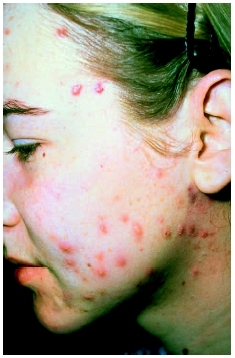
Acne is a condition in which pimples appear on the face, chest, and back. In teenagers, acne usually appears on the forehead, nose, and chin. It is caused by the overproduction of sebum. Sebum is an oily substance that forms in glands just under the surface of the skin called sebaceous glands. Sebum normally flows out hair follicles onto the skin to act as a natural skin moisturizer. The glands are connected to hair follicles that allow the sebum, or oil, to empty onto the skin through a pore.
If hair follicles become blocked by sebum, dead skin cells, and bacteria, acne is the result. The sebaceous gland units are most commonly found on the face, neck, and back.
During puberty, there are increased levels of the male hormone androgen. High levels of androgen cause excess sebum to form. Sometimes the sebum combines with dead, sticky skin cells and bacteria called Propioni-bacterium acnes (P. acnes) that normally live on the skin. The mixture of oil and cells allows the bacteria to grow in the plugged follicles. When this happens, a hard plug called a comedo can form. A comedo is an enlarged hair follicle. It can take the following forms:
- a blackhead, which is a comedo that reaches the skin's surface and looks black
- a whitehead, which is a comedo that is sealed by keratin, the fibrous protein produced by the skin cells and looks like a white bump.
In addition, pimples can form on the skin. Types of pimples include:
- papules, which are small, red bumps that may be tender to the touch
- pustules, which are pus-filled lesions that are often red at the base
- nodules, which are large, painful lesions deep in the skin
- cysts, which are painful pus-filled lesions deep in the skin that can cause scarring
Pimples form when the follicle is invaded by the P. acnes bacteria. The damaged follicle weakens and bursts open, releasing sebum, bacteria, skin cells, and white blood cells into surrounding tissues. Scarring happens when new skin cells are created to replace the damaged cells. The most severe type of acne includes both nodules and cysts.
Demographics
Acne affects as many as 17 million people in the United States, making it the most common skin disease. Acne usually begins at puberty and worsens during adolescence . Nearly 85 percent of people develop acne at some point between ages 12 to 25. As many as 20 million teens have the condition. Acne may appear as early as age 10, and even may be found in some newborns. Some people may continue to be affected by acne after age 30.
Causes and symptoms
The exact cause of acne is as of 2004 not known. There are several risk factors that make acne more likely to occur:
- Age. Adolescents are more likely to have acne.
- Disease. Certain hormonal disorders such as polycystic ovarian syndrome make acne more likely.
- Hormonal changes. Acne can flare up before menstruation . An increase in the male hormone androgen during puberty (seen in both males and females) causes the sebaceous glands to overproduce androgen. Boys have more severe acne than girls.
- Heredity. Some individual are genetically more susceptible to acne.
- Drugs. Steroids and performance enhancing drugs, oral contraceptives, antibiotics, antidepressants , and tranquillizers such as lithium are known to cause acne.
- Cosmetics. Oily cosmetics can plug up hair follicles.
Other factors can worsen acne or cause it to flare up:
- Environmental irritants. Air pollution and high humidity can worsen acne, as can exposure to greasy environments such as working in a fast food restaurant.
- Friction. Rubbing the skin vigorously or exposure to constant friction from backpacks or tight collars can worsen acne.
- Personal hygiene. Picking at pimples or scrubbing the skin too hard can result in worsened acne.
Factors that do not cause acne include:
- chocolate and greasy foods
- stress
When to call the doctor
A healthcare provider should be contacted under the following circumstances:
- Painful nodules and cysts are present.
- Over-the-counter medications have not been effective.
- Acne lesions are causing scarring.
- Acne is causing dark skin to have darker patches when lesions heal.
- Acne is causing embarrassment or self-consciousness.
- Acne is creating emotional upset.
Acne may be treated by the family doctor. More severe cases may be referred to a dermatologist (skin doctor) or an endocrinologist (doctor who treats hormonal/glandular disorders).
Diagnosis
Acne can be diagnosed by physical examination and a medical history of acne. The physician will take a medical history, including information about skin care, diet, medications, factors that can cause flare-ups, and prior treatment. Blood tests are not usually necessary unless a hormonal disorder is suspected.
Physical examination will include the face, neck, shoulders, back, and other affected areas. Using specialized lighting, the physician will examine the affected areas to see the following:
- what type and how many lesions are present
- how deep the lesions are
- whether they are inflamed
- whether scarring or skin discoloration is present
Treatment
Acne treatment consists of reducing the sebum production, removing dead skin cells, and killing bacteria with oral medication and drugs used on the skin (topical). The treatment depends on the severity of the condition.
Drugs
TOPICAL (SKIN) MEDICATION Treatment for mild noninflammatory acne consists of reducing the formation of new comedones with medications including topical tretinoin, benzoyl peroxide, adapalene, or salicylic acid. Tretinoin is especially effective because it increases turnover and replacement of skin cells. If lesions are inflamed, topical antibiotics may be added to the treatment regimen. Improvement is usually seen in two to four weeks.
Topical medications are available as cream, gel, lotion, or pad preparations of varying strengths. They include antibiotics (to kill bacteria) such as erythromycin, clindamycin (Cleocin-T), and meclocycline (Meclan); and comedolytics (agents that loosen hard plugs and open pores) such as the vitamin A acid tretinoin (Retin-A), salicylic acid, adapalene (Differin), resorcinol, and sulfur. Drugs that act as both comedolytics and antibiotics, such as benzoyl peroxide, azelaic acid (Azelex), or benzoyl peroxide plus erythromycin (Benzamycin), are also used. These drugs may be used for months to years to achieve disease control.
After the person washes with mild soap, the drugs are applied alone or in combination, once or twice a day over the entire affected area of skin. Possible side effects include mild redness, peeling, irritation, dryness, and an increased sensitivity to sunlight that requires use of a sunscreen.
ORAL DRUGS Oral antibiotics are taken daily for two to four months. The drugs used include tetracycline, erythromycin, minocycline (Minocin), doxycycline, clindamycin (Cleocin), and trimethoprim-sulfamethoxazole (Bactrim, Septra). Possible side effects include allergic reactions, stomach upset, vaginal yeast infections, dizziness , and tooth discoloration.
The goal of treating moderate acne is to decrease inflammation and prevent new comedones from forming. One effective treatment is topical tretinoin, used along with a topical or oral antibiotic. A combination of topical benzoyl peroxide and erythromycin is also very effective. Improvement is normally seen within four to six weeks, but treatment is maintained for at least two to four months.
A drug reserved for the treatment of severe acne, oral isotretinoin (Accutane), reduces sebum production and cell stickiness. It is the treatment of choice for severe acne with cysts and nodules and is used with or without topical or oral antibiotics. Taken for four to five months, it provides long-term disease control in up to 60 percent of patients. If the acne reappears, another course of isotretinoin may be needed by about 20 percent of patients, while another 20 percent may do well with topical drugs or oral antibiotics. However there are significant side effects, including temporary worsening of the acne; dry skin; nosebleeds; vision disorders; and elevated liver enzymes, blood fats, and cholesterol. The drug also causes benign intracranial hypertension (pseudotumor cerebri) and mood changes. This drug must not be taken during pregnancy since it causes birth defects. Sexually active young women being treated with isotretinoin must use a reliable contractive, and they need to use contraception for up to one month after stopping use of the drug.
Anti-androgens, drugs that inhibit androgen production, are used to treat women who are unresponsive to other therapies. Certain types of oral contraceptives (for example, Ortho-Tri-Cyclen) and female sex hormones (estrogens) reduce hormone activity in the ovaries. Other drugs (for example, spironolactone and corticosteroids) reduce hormone activity in the adrenal glands. Improvement may take up to four months.
Oral corticosteroids, or anti-inflammatory drugs, are the treatment of choice for an extremely severe, but rare type of destructive inflammatory acne called acne fulminans, found mostly in adolescent males. Acne conglobata, a more common form of severe inflammation, includes numerous, deep, inflammatory nodules that heal with scarring. It is treated with oral isotretinoin and corticosteroids.
Other treatments
Several surgical or medical treatments are available to alleviate acne or the resulting scars:
- Comedone extraction. The comedo is removed from the pore with a special tool.
- Chemical peels. Glycolic acid is applied to peel off the top layer of skin to reduce scarring.
- Dermabrasion. The affected skin is frozen with a chemical spray and removed by brushing or planing.
- Punch grafting. Deep scars are excised and the area repaired with small skin grafts.
- Intralesional injection. Corticosteroids are injected directly into inflamed pimples.
- Collagen injection. Shallow scars are elevated by collagen (protein) injections.
Alternative treatment
Alternative treatments for acne focus on self care: proper cleansing to keep the skin oil-free; eating a well-balanced diet high in fiber, zinc, and raw foods; and avoiding alcohol, dairy products, tobacco, caffeine , sugar, processed foods, and foods high in iodine, such as salt.
Supplementation with herbs such as burdock root ( Arctium lappa ), red clover ( Trifolium pratense ), and milk thistle ( Silybum marianum ), and with nutrients such as essential fatty acids, vitamin B complex, zinc, vitamin A, and chromium is also recommended. Chinese herbal remedies used for acne include cnidium seed ( Cnidium monnieri ) and honeysuckle flower ( Lonicera japonica ). Holistic physicians or nutritionists can recommend the proper amounts of these herbs.
Nutritional concerns
Acne is not caused or worsened by eating chocolate or oily foods.
Prognosis
Acne is not curable, although it can be controlled by proper treatment. Improvement can take two or more months. Long-term control is achieved in up to 60 percent of patients with severe acne who are treated with the drug isotretinoin. Acne tends to reappear when treatment stops, but spontaneously improves over time. Acne usually improves after adolescence, although some individuals continue to have lesions after age 30. Inflammatory acne may leave scars that require further treatment.
Prevention
There are no sure ways to prevent acne, but the following steps may be taken to minimize flare-ups:
- gentle washing of affected areas once or twice every day
- avoiding abrasive cleansers
- using noncomedogenic (does not clog pores) makeup and moisturizers
- shampooing often and wearing hair off the face
- eating a well-balanced diet, avoiding foods that trigger flare-ups
- unless told otherwise by the healthcare provider, giving dry pimples a limited amount of sun exposure
- not picking or squeezing blemishes
Parental concerns
Acne comes at a difficult time, during the adolescent years. While mild acne can be treated with over-the-counter medications, more severe acne needs medical attention. Experts advise against a wait-and-see attitude. Treatment options can help control acne and avoid scarring.
KEY TERMS
Androgens —Hormones (specifically testosterone) responsible for male sex characteristics.
Antiandrogen —A substance that blocks the action of androgens, the hormones responsible for male characteristics.
Antibiotics —Drugs that are designed to kill or inhibit the growth of the bacteria that cause infections.
Comedo —A hard plug composed of sebum and dead skin cells, also called a blackhead. The mildest type of acne.
Comedolytic drugs —Medications that break up comedones and open clogged pores.
Corticosteroids —A group of hormones produced naturally by the adrenal gland or manufactured synthetically. They are often used to treat inflammation. Examples include cortisone and prednisone.
Estrogen —Female hormone produced mainly by the ovaries and released by the follicles as they mature. Responsible for female sexual characteristics, estrogen stimulates and triggers a response from at least 300 tissues. After menopause, the production of the hormone gradually stops.
Isotretinoin —A powerful vitamin A derivative used in the treatment of acne.
Noncomedogenic —A substance that does not contribute to the formation of blackheads or pimples on the skin.
Sebaceous follicle —A structure found within the skin where a sebaceous gland opens into a hair follicle.
Sebum —An oily skin moisturizer produced by sebaceous glands.
Tretinoin —A drug, used in the treatment of acne, that works by increasing the turnover (death and replacement) of skin cells.
See also Antiacne drugs .
Resources
BOOKS
Ceaser, Jennifer. Everything You Need to Know about Acne. New York: Rosen Publishing Group, 2003.
Papadopoulos, Linda, et al. Understanding Skin Problems: Acne, Eczema, Psoriasis, and Related Conditions. New York: John Wiley and Sons, 2003.
Preston, Lydia, et al. Breaking Out: A Woman's Guide to Coping with Acne. New York: Simon & Schuster, 2004.
ORGANIZATIONS
American Academy of Dermatology. 930 E. Woodfield Rd., Schaumburg, IL 60168. Web site: http://www.aad.org/.
WEB SITES
"Questions and Answers about Acne." National Institute of Arthritis and Musculoskeletal and Skin Diseases (NIAMS) Information Clearinghouse , October 2001. Available online at http://www.niams.nih.gov/hi/topics/acne/acne.htm (accessed October 15, 2004).
"Treating Acne in Skin of Color." AcneNet 2002. Available online at http://www.skincarephysicians.com/acnenet/update.htm (accessed October 15, 2004).
"What Can I Do About Pimples?" American Family Physician, Information from Your Family Doctor Handout , January 15, 2000. Available online at http://www.aafp.org/afp/20000115/20000115a.html (accessed October 15, 2004).
Christine Kuehn Kelly