Neonatal reflexes

Definition
Neonatal reflexes or primitive reflexes are the inborn behavioral patterns that develop during uterine life. They should be fully present at birth and are gradually inhibited by higher centers in the brain during the first three to 12 months of postnatal life. These reflexes, which are essential for a newborn's survival immediately after birth, include sucking, swallowing, blinking, urinating, hiccupping, and defecating. These typical reflexes are not learned; they are involuntary and necessary for survival.
Description
A normal birth is considered full term if the delivery occurs during the thirty-seventh to fortieth week after conception. Developmentally, the baby is considered a neonate for the first 28 days of life. At birth, the neonate must immediately make five major adjustments:
- Transition from an aquatic environment to a world of air. The first breath begins even before the umbilical cord is cut.
- Eat and digest his or her own food since the circulatory relationship between mother and baby stops with the severance of the umbilical cord.
- Excrete his or her own wastes.
- Maintain his or her own body temperature.
- Adjust to intermittent feeding since food is now only available at certain intervals.
Under normal developmental conditions, these neonatal reflexes represent important reactions of the nervous system and are only observable within a specific period of time over the first few months of life. The following reflexes are normally present from birth and are part of a normal newborn evaluation:
- The Moro reflex (or startle reflex) occurs when an infant is lying in a supine position and is stimulated by a sudden loud noise that causes rapid or sudden movement of the infant's head. This stimulus results in a symmetrical extension of the infant's extremities while forming a C shape with the thumb and forefinger. This is followed by a return to a flexed position with extremities against the body. Inhibition of this reflex occurs from the third to the sixth month. An asymmetrical response with this reflex may indicate a fractured clavicle or a birth injury to the nerves of the arm. Absence of this reflex in the neonate is an ominous implication of underlying neurological damage.
- Asymmetrical tonic neck reflex (sometimes called the tonic labyrinthine reflex) is activated as a result of turning the head to one side. As the head is turned, the arm and leg on the same side will extend while the opposite limbs bend, in a pose that mimics a fencer. The reflex should be inhibited by six months of age in the waking state. If this reflex is still present at eight to nine months of age, the baby will not be able to support its weight by straightening its arms and bringing its knees beneath its body.
- Symmetrical tonic neck reflex occurs with either the extension or flexion of the infant's head. Extension of the head results in extension of the arms and flexion of the legs, and a flexion of the head causes flexion of the arms and an extension of the legs. This reflex becomes inhibited by the sixth month to enable crawling.
- Grasping reflex occurs as the palmar reflex when a finger is placed in the neonate's palm and the neonate grasps the finger. The palmar reflex disappears around the sixth month. Similarly, the plantar reflex occurs by placing a finger against the base of the neonate's toes and the toes curl downward to grasp the finger. This reflex becomes inhibited around the ninth to tenth month.
- Rooting reflex is stimulated by touching a finger to the infant's cheek or the corner of the mouth. The neonate responds by turning the head toward the stimulus, opening the mouth and searching for the stimulus. This is a necessary reflex triggered by the mother's nipple during breastfeeding. It is usually inhibited by the third to fourth month.
- Sucking reflex is triggered by placing a finger or the mother's nipple in the infant's mouth. The neonate will suck on the finger or nipple forcefully and rhythmically and the sucking is coordinated with swallowing. Like the rooting reflex, it is inhibited by the third to fourth month.
- Babinski or plantar reflex is triggered by stroking one side of the infant's foot upward from the heel and across the ball of the foot. The infant responds by hyperextending the toes; the great toe flexes toward the top of the foot and the other toes fan outward. It generally becomes inhibited from the sixth to ninth month of post natal life.
- Blink reflex is stimulated by momentarily shining a bright light directly into the neonate's eyes causing him or her to blink. This reflex should not become inhibited.
- Pupillary reflex occurs with darkening the room and shining a penlight directly into the neonate's eye for several seconds. The pupils should both constrict equally; this reflex should not disappear.
- Galant reflex is stimulated by placing the infant on the stomach or lightly supporting him or her under the abdomen with a hand and, using a fingernail, gently stroking one side of the neonate's spinal column from the head to the buttocks. The response occurs with the neonate's trunk curving toward the stimulated side. This reflex can become inhibited at any time between the first and third month.
-
Stepping reflex is observed by holding the infant in an upright position
and touching one foot lightly to a flat
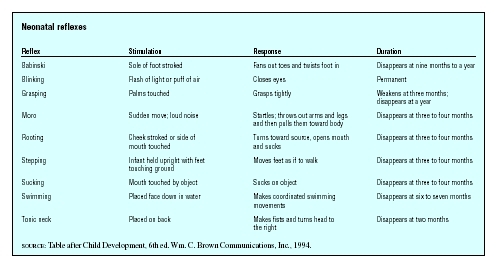 Neonatal reflexes(Table by GGS Information Services.)
surface, such as the bed. The infant responds by making walking motions with both feet. This reflex will disappear at approximately two months of age.Reflex Stimulation Response Duration SOURCE : Table after Child Development, 6th ed. Wm. C. Brown Communications, Inc., 1994. Babinski Sole of foot stroked Fans out toes and twists foot in Disappears at nine months to a year Blinking Flash of light or puff of air Closes eyes Permanent Grasping Palms touched Grasps tightly Weakens at three months; disappears at a year Moro Sudden move; loud noise Startles; throws out arms and legs and then pulls them toward body Disappears at three to four months Rooting Cheek stroked or side of mouth touched Turns toward source, opens mouth and sucks Disappears at three to four months Stepping Infant held upright with feet touching ground Moves feet as if to walk Disappears at three to four months Sucking Mouth touched by object Sucks on object Disappears at three to four months Swimming Placed face down in water Makes coordinated swimming movements Disappears at six to seven months Tonic neck Placed on back Makes fists and turns head to the right Disappears at two months - Prone crawl reflex can be stimulated by placing the neonate prone (face down) on a flat surface. The neonate will attempt to crawl forward using the arms and legs. This reflex will be inhibited by three to four months of age.
- Doll's eye reflex can be noted with the infant supine (lying on the back) and slowly turning the head to either side. The infant's eyes will remain stationary. This reflex should disappear between three to four months of age.
Common problems
The presence and strength of a reflex is an important indication of neurological functioning. Within the first 24 hours after birth, a healthcare provider evaluates an infant's neurological functioning and development by testing and observing these reflexes. If a reflex is absent or abnormal in an infant, this may suggest significant neurological problems. In normal development, the primary reflex system is inhibited or transformed in the first year of life and a secondary or postural reflex system emerges. The secondary system forms the basis for later adult coordinated movement. Absence or presence of a reflex is a symptom, not a disorder.
Severe persistence of primary reflexes indicates predominantly persistent physical problems. Relatively milder persistence, however, is associated with less severe disorders that include specific reading difficulties.
The process of inhibition of these reflexes in the earliest months of life remains unknown but it has been assumed that this process cannot occur after early childhood because neonatal movement is largely stereotypical and follows the patterns of the primary reflex system. Thus, the early movements of the fetus and newborn were previously viewed as passive byproducts of the central nervous system. They are viewed as interactive and having a reciprocal effect on the underlying central nervous system structure and functioning. This implies that the actual rehearsal and repetition of primary reflex movements play a role in the inhibition process itself.
Parental concerns
An evaluation of neonatal reflexes is performed during well-baby examinations. The abnormal presence of infantile reflexes in an older child can be discovered during a neurological examination. Assessment of neonatal reflexes is a screening tool for at-risk children with neurological difficulties. Primary reflexes may persist for certain children beyond their normal time span causing a disruption in subsequent development. Children with neurological damage will have a common denominator of prolonged neonatal reflexes. Since recent studies have demonstrated that repetition of these reflexes seems to eventually inhibit them, parents can work with the infant by assisting with the repetition of persistent reflexes.
When to call the doctor
Persistence of neonatal reflexes is not threatening to life and, therefore, can be discussed with the pediatrician during normal well-baby visits.
KEY TERMS
Palmar —Referring to the palm of the hand.
Plantar —Relating to the sole of the foot.
Postural —Pertaining to the position of the head, neck, trunk and lower limbs in relation to the ground and the vertical.
Prone —Lying on the stomach with the face downward.
Supine —Lying on the back with the face upward.
Visuosensory —Pertaining to the perception of visual stimuli.
Resources
BOOKS
Blythe, Peter. The Role of the Primitive Asymmetrical Tonic Neck Reflex (ATNR) in Balance, Co-ordination Problems and Specific Learning Difficulties, including Dyslexia. Chester, UK: INPP, Monograph 2002.
Goddard, Sally. Reflexes, Learning and Behavior. Eugene, OR: Fern Ridge Press, 2002.
Seidel, Henry M., Rosenstein, et al. Primary Care of the Newborn, 3rd ed. St. Louis, MO: Mosby, 2001.
PERIODICALS
Bein-Wierzbinski, W. "Persistent Primitive Reflexes in Elementary School Children." Presented at the 13th European Conference of Neuro-Developmental Delay in Children with Specific Learning Difficulties Chester, UK (2001).
Blythe, Sally G. "Neurological Dysfunction, a Developmental Movement Programme used in Schools and the Effect upon Education." The Bangor Dyslexia Conference, University of Bangor, North Wales (July 2003).
ORGANIZATIONS
American Academy of Pediatrics. 141 Northwest Point Blvd., Elk Grove Village, IL 60007-1098. (847) 434-4000. Web site: http://www.aap.org..
The International Dyslexia Association. Chester Building, Suite 382;8600 LaSalle Road; Baltimore, MD 21286-2044. (410) 296-0232 or (800) 222-3123. Web site: http://www.interdys.org.
WEB SITES
Primary Movement 2004. Available online at http://www.primarymovement.org.
Primitive and Postural Reflexes—The Theory. Available online at http://www.inpp.org.uk/htm.
Linda K. Bennington, MSN, CNS
Comment about this article, ask questions, or add new information about this topic: